The revision that wasn't in the contract
It starts with “could we try it in green too?” and ends with you on revision nine of a project you quoted for three. Here's why it's really a line nobody drew, and the system that makes that line visible before it eats your weekend.

Made with ChatGPT (ChatGPT Images 2.0 (gpt-image-2))view prompthide prompt
Create an editorial magazine illustration in a hand-painted style with visible soft brushstrokes and subtle oil-painting texture. NOT photoreal, NOT a 3D render. Palette: cool slate-navy and warm cream with selective deep cobalt blue accents, cinematic 16:9 widescreen. Composition: a vintage brass gauge or meter sitting on a creative's wooden desk, its single needle swung hard to the far right, well past a small marked limit, into a glowing deep-cobalt-blue 'over' zone on the dial. Around it a few design tools and papers carry on as if no one is watching it. A quiet sense of a meter running unnoticed. No readable numbers, no readable text, no logos, no people.
Hero for the scope-creep piece. The article's own line — 'there's a meter running, you never showed them one' — made literal. Non-phone.
The project was supposed to ship two weeks ago.
It would have, except for the messages. They started friendly. “This is great, could we try the logo in green too?” Sure. “Love it. Quick thing, can the tagline be a little bigger?” Of course. “Last one, promise: my partner wants to see two more layout options.”
None of them was worth a fight. Each took twenty minutes, or felt like it would, and the alternative was being the difficult one over a tagline.
It's Sunday night. You canceled dinner for this, again. You're on revision nine of a project you quoted for three, the file's been almost-done for nine days, and every time you open it to finish, there's one more thing. The client is thrilled. You're doing a second project for free and calling it finishing the first.
The maddening part is that the client has no idea. From their side they made a few small requests and you happily said yes every time. There's no villain in this story. They aren't trying to rob you; they genuinely don't know there's a meter running, because you never showed them one. So you sit there quietly resenting someone who thinks the whole thing is going great.
Scope creep never arrives as scope creep
It arrives as a string of small, reasonable favors, each too minor to argue over, spaced just far enough apart that you never catch the pattern until the weekend's already gone.
Drop a frog in boiling water and it jumps. Warm the water one degree at a time and it never does.
And it works every single time for a reason that has nothing to do with how closely you were watching. You felt every one of those requests land. The trouble is that the line you'd have to point to lives in a proposal you both signed and neither of you has opened since, while the requests live in your inbox, three DMs, and a comment someone made on a call. The line was never drawn anywhere you could stand on it. So saying “that's past what we agreed” feels less like stating a fact and more like starting a fight.
Quick gut check: can you say, off the top of your head, how many revision rounds your last three projects were quoted for? If not, the line was never visible to you either, and that invisible line is where the trouble always starts.
Scope creep isn't a client problem. It's a line nobody drew.
You say yes every time for a reason that's actually good. You're protecting the relationship. The whole business runs on clients liking you enough to come back and send their friends, and a flat “no” feels like sand in those gears. So you eat the hours and file it under investment. The instinct is right. The method is what's quietly bleeding you.
Put the line where you can both see it
The fix is to take the job of watching the line off your shoulders and hand it to a system. Three pieces.
First, write the scope so a normal person can check against it. Not legalese. Deliverables, and a number of revision rounds, stated plainly enough that both of you, and a machine, could tell whether a given request falls inside it.
Plain looks like: three rounds of revisions, two logo directions, final files in the formats they need, anything past that is a separate quote. Vague looks like: we'll refine it until you're happy. One of those has a line in it. The other is an open bar.
And say what a round actually is, or the number protects nothing. A round is one batch of feedback, collected and sent at once, not a steady trickle of one-off notes across nine days. Leave that undefined and “three rounds” quietly turns into thirty, one reasonable text at a time, and you're right back where you started.
Second, have something actually watch the incoming requests against that line: reading what the client just asked for against what you agreed to, and quietly flagging the moment a request crosses over. “Heads up, that's revision four of three.” It's the kind of patient, repetitive watching that's miserable for a person and trivial to hand off.
Here's the catch: the software you already pay for doesn't do this part. The freelancer suites, Bonsai, HoneyBook, Dubsado, Moxie, help you write a tight scope and a change-order template, then leave you to enforce it by hand. Even the AI baked into the big project trackers watches your own task list for drift, not the client's inbox against your agreement. A handful of brand-new tools are just starting to fill that gap; it simply isn't built into the apps you run your business on yet, which is why most people are still doing the watching themselves, badly, at 11 p.m.
The flag exists so that revision four becomes a decision you make on purpose, in daylight, instead of something that happens to you at 11 p.m. on a Sunday. You can still wave it through. The difference is you chose to.
Third, have the words ready before you need them. You cave in the moment because pushing back cold feels confrontational. It stops feeling that way when the reply is already written and sitting there waiting for you.
Made with ChatGPT (ChatGPT Images 2.0 (gpt-image-2))view prompthide prompt
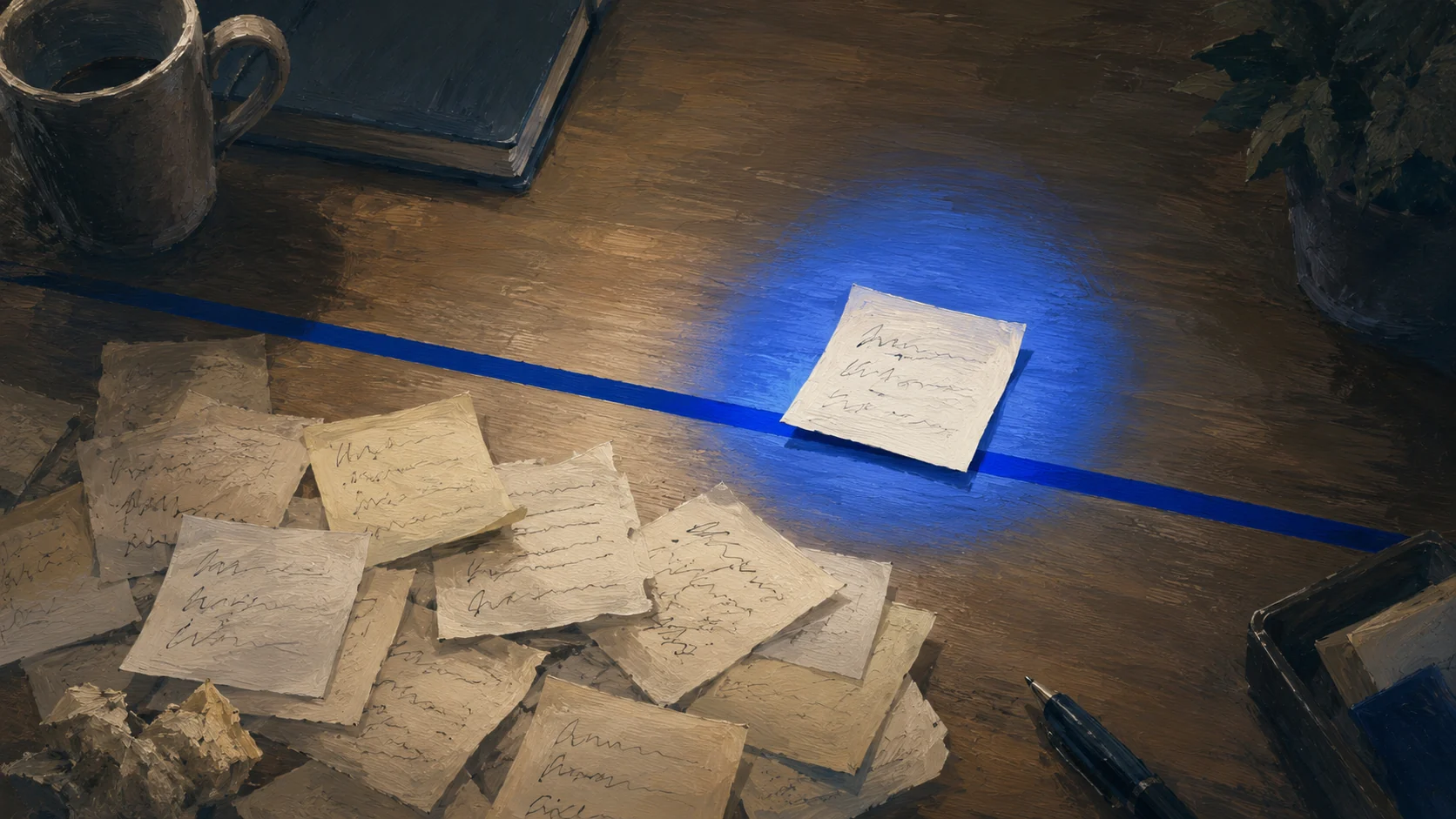
Create an editorial magazine illustration in a hand-painted style with visible soft brushstrokes and subtle oil-painting texture. NOT photoreal, NOT a 3D render. Palette: cool slate-navy and warm cream with selective deep cobalt blue accents, cinematic 16:9 widescreen. Composition: a wooden desk with a single crisp deep-cobalt-blue line drawn across it; a small drift of handwritten request notes piles up to the near side of the line, and one note that has crossed the line is caught in a soft cobalt-blue spotlight, gently flagged, while the rest stay behind the line. A sense of the over-scope request finally being caught in time. No people, no readable text, no logos.
Mid image, after the fix. The scope guardian catching the request that crossed the line. Non-phone.
When we set this up for a small studio that was losing a weekend to nearly every project, we didn't change a thing about how they talk to clients. We changed what they could see. Their agreed scope went into the system in plain terms. Requests coming in by email or Slack got checked against it, and anything past the line pinged the owner with a one-line draft reply she could send or ignore.
She stopped finding out she'd over-delivered on a Sunday night. She started catching it on a Tuesday, in time to send a friendly quote instead of swallowing the hours.
Her work didn't change. Her clients never noticed a new policy or got a colder studio. The only thing that changed was that the meter was finally visible, to her, in time to do something other than absorb it. Within a couple of months the “quick tweaks” had quietly turned back into either real add-on invoices or genuine small favors she chose to give, on purpose.
Go add up the quick tweaks from your last five projects. Be honest about the hours.
That is, quietly, a whole project's worth of work you gave away for free, because nobody was counting it.
And the hours are the smaller half of it. While you're buried finishing that free second project, you're not pitching, not making, not taking the next paying job. Every weekend spent over-delivering is a weekend you didn't spend on the work that actually grows the studio.
But won't a boundary make me seem cold?
This is the fear that keeps the whole pattern alive, so it's worth answering straight. The thing that actually damages a client relationship is the slow resentment that builds when you over-deliver in silence: the edge that creeps into your replies by revision seven, the way you start dreading their name in your inbox, the deadline you quietly let slip because you're so far underwater. A clearly-stated boundary does none of that. Clients feel the resentment long before they could ever name it.
“That's an add-on, want me to go ahead?” reads as a professional running a real business. Saying yes to everything and then going slow, cold, and a little checked-out reads as someone who stopped caring. The boundary is the thing that lets you keep genuinely liking the client, which is what the relationship actually runs on.
None of this is about charging for every kindness. Throw in the small stuff. A five-minute favor buys a lot of goodwill, and clients remember the studio that didn't nickel-and-dime them over a font swap. The point is narrower: catch the moment a favor turns into a second job, while you can still say something about it.
If most of your projects quietly run long, the problem sits upstream of your willpower: a system that can't see the line. Start a no-pressure conversation and we'll find where your scope leaks and set up the thing that watches it. Your designs stay yours. Your Sundays mostly come back.
Cheers, from the boring side of the business,

P.S. The cleanest place to stop scope creep is before the work even starts, in how you take it in. That's the next one.
Want help applying this to your business? Start a no-pressure conversation →
Frequently asked questions
- How do you handle scope creep in creative work?
- Make the scope visible and give something other than your in-the-moment goodwill the job of watching it. State deliverables and a number of revision rounds plainly in the proposal, track incoming requests against that line, and have a friendly, pre-written reply ready that turns an out-of-scope ask into a quick add-on quote. The goal is to catch the moment a favor becomes a second project, while you can still say something about it.
- How do I tell a client a request is out of scope without sounding difficult?
- Say yes to the request and to the boundary at the same time: “Happy to do that one. Heads up, it's outside the three rounds we set, so I'll send a quick add-on for it, want me to go ahead?” It's specific, friendly, and puts the decision back on them. Most clients say yes, because the request was genuine. The ones who balk were the ones quietly counting on a free second project.
- How many revision rounds should I include?
- Whatever you pick matters less than stating it plainly and tracking against it. Two or three named rounds is common for brand and design work. The number isn't the protection; the protection is that both sides can see it and someone is counting, so revision four is a conversation instead of a silent freebie.
- Why do I keep going over scope even though I know better?
- Because scope creep is designed, accidentally, to beat willpower. The asks are small, reasonable, and spaced out, so no single one feels worth a fight, and pushing back cold in the moment feels confrontational. You see every request land; it's just that none of them ever looks like the battle until the weekend's already gone. The fix is a system that draws the line for you and hands you the words before you need them.
- Can AI help manage scope creep?
- Yes, and it's one of the few genuinely useful things AI does here: reading what a client just asked for against what you agreed to, and flagging the moment a request crosses the line. That patient, repetitive watching is miserable for a human and trivial to automate. The all-in-one tools most freelancers use, Bonsai, HoneyBook, Dubsado, don't do it; they hand you a contract template and leave the watching to you. A few dedicated tools launched in 2026 doing exactly this, so it's no longer impossible to buy, it's just not built into the platform you already run your business on. It watches the business side; it never touches your design.