Automate your business, never your art
We're an AI company telling creatives to keep AI off their craft. Here's the line that makes that make sense, and why protecting the art is the move that actually makes money.
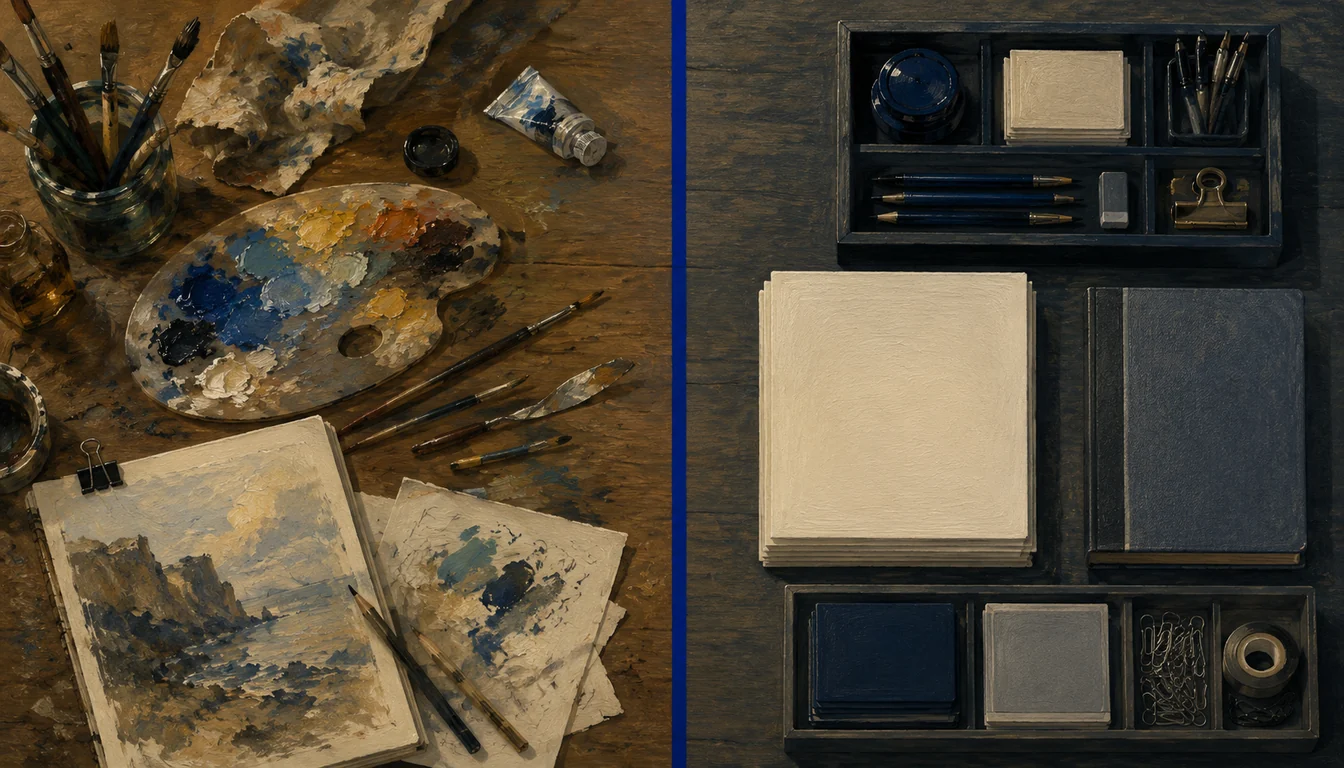
Made with ChatGPT (ChatGPT Images 2.0 (gpt-image-2))view prompthide prompt
Create an editorial magazine illustration in a hand-painted style with visible soft brushstrokes and subtle oil-painting texture. NOT photoreal, NOT a 3D render. Palette: cool slate-navy and warm cream with selective deep cobalt blue accents, cinematic 16:9 widescreen. Composition: an overhead view of a creative's wooden desk divided straight down the middle by a single clean deep-cobalt-blue line. The left side is warm and alive: paintbrushes, a palette, a sketch in progress, creative tools in pleasant disarray. The right side is cooler and perfectly orderly: a neat squared-off stack of papers, a tidy ledger, an organized tray. The dividing line is the subject. No people, no readable text or letterforms, no logos.
Hero for the manifesto. The thesis made visible: craft on one side, business on the other, a clear cobalt line between. Non-phone.
Let's get the awkward part out of the way. We set up AI systems for a living, and we think most of what AI is being sold to creatives right now is a trap.
This has nothing to do with AI being evil, and everything to do with which half of your work everyone keeps pointing it at.
They're aiming at the wrong half.
The trap everyone is selling you
Open any feed and the pitch never changes. AI to make more, faster. Ten logos in ten seconds, a month of posts in an afternoon, 10x your output. At 11 p.m. with three deadlines stacked up, it sounds like mercy.
Here's the catch.
Your output is the exact thing that just got commoditized. The market is already waist-deep in generated work that, as people keep saying, feels like no one made it. Every "10x your designs" tool pours more into that flood, and the flood is what you're bidding against.
It trains your clients, too. Run the work through a generator and the whole market absorbs the lesson: this is a commodity, it should be cheaper, the nephew with a free tool counts as competition. Point AI at your craft and you start underbidding a version of yourself that works for nothing and doesn't care how it turns out.
There's a quieter tax on top of that. The tools all drift toward the same look. Same polish, same safe gradients, same blobby mascots nobody chose. Lean on them long enough and your portfolio starts to resemble everyone else's who leaned on the same tool, and the thing that made your work recognizably yours sands down a little with every piece.
You feel it before you can name it.
So that's the trap, and it's a clean one. The tools sold to rescue creatives mostly speed up the one thing quietly killing their rates.
Draw a line down the middle of your business
So draw one. Right down the middle of what you do.
One side is the craft. The taste, the judgment, the calls only you would make, the reason a client picked you and couldn't say why. That is your moat.
Keep AI's hands off it. It's the only thing you own that doesn't turn into a commodity the second a machine can do everything else.
The other side is the business. Intake emails. Proposals. Scheduling. The follow-ups you keep meaning to send. Invoices. The contract you've rewritten by hand a hundred times.
None of that is why you became a designer. All of it can run on its own this week, without anyone laying a finger on the actual work.
Here's why the craft is the real moat: you can't write it down. Hand a machine a perfect, detailed brief and the client still won't get what they wanted, because what they wanted lived in a hundred tiny judgment calls they could never put into words and you make without thinking. That gap is your whole business.
Automating the thing that lives in the gap is the one move that makes no sense at all.
The craft (keep AI's hands off it)
- The creative judgment and taste
- The final call on what ships
- The directions only you would think of
- The thing clients can't name but pay for
The business (automate it without guilt)
- Intake, qualifying, and first replies
- Proposals and the cost-of-getting-it-wrong framing
- Scheduling, reminders, and follow-ups
- Invoicing and the hundredth contract rewrite
Automate the business. Never the art. That's the whole strategy.
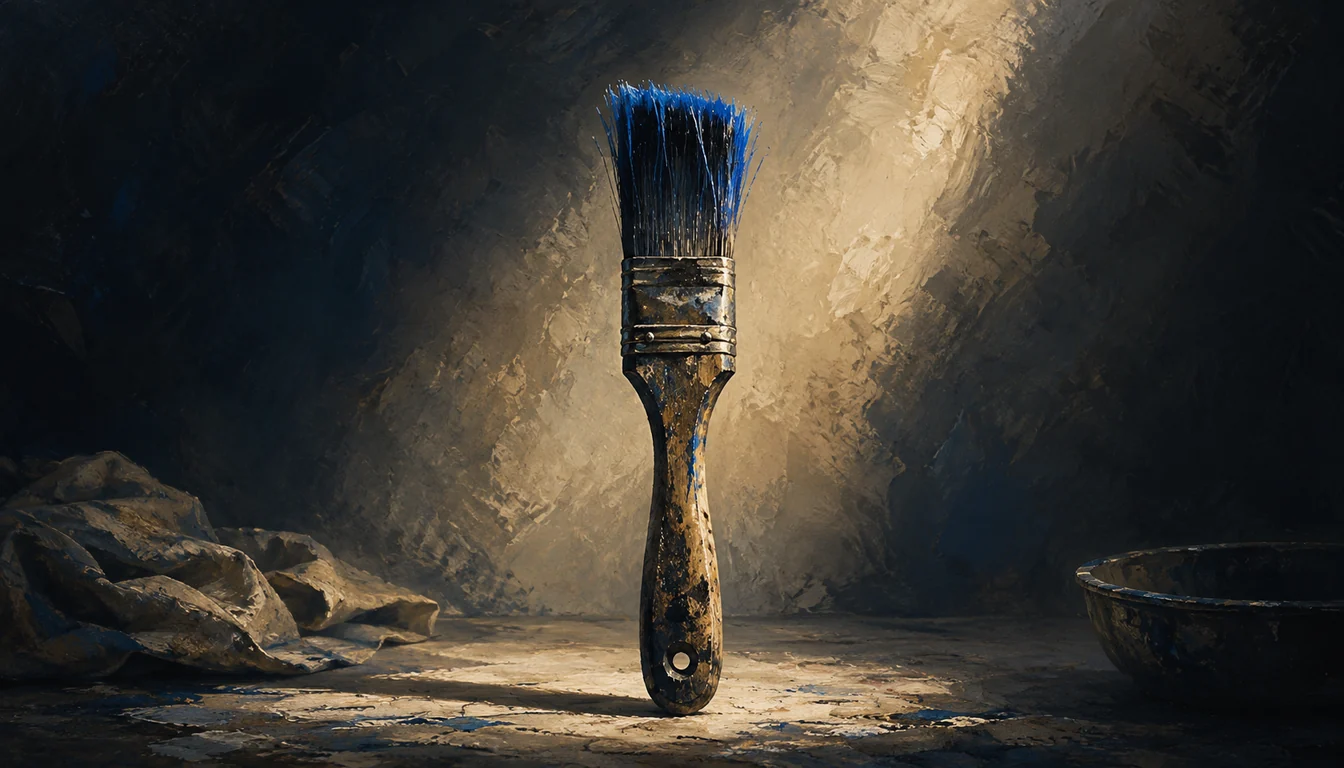
Made with ChatGPT (ChatGPT Images 2.0 (gpt-image-2))view prompthide prompt
Create an editorial magazine illustration in a hand-painted style with visible soft brushstrokes and subtle oil-painting texture. NOT photoreal, NOT a 3D render. Palette: cool slate-navy and warm cream with selective deep cobalt blue accents, cinematic 16:9 widescreen. Composition: an intimate still life of a single well-worn paintbrush standing upright, caught in a warm pool of directional light against deep surrounding shadow, a subtle deep-cobalt-blue glow along the bristles. A sense of reverence for the tool and the hand behind it. No people, no readable text, no logos.
Mid image, after the comparison/pull-quote. The protected craft, the moat; reinforces 'never the art.' Non-phone.
This is the version that makes money
In case the high road wasn't motivation enough on its own: this is also the version that makes more of it.
The craft stays scarce, so it stays worth paying for. The clients who matter hire you because the work isn't machine-made, and they can tell faster than you'd think. Meanwhile the admin you finally automated was never billable anyway.
You're cutting the hours you give away and guarding the hours you charge for.
Run the math on your own week. The time you lost to intake and scheduling and chasing invoices last month was unpaid, all of it. The time you spent designing was the part that earned. Buying back the first to make room for the second is the best trade in your business, and it costs you nothing of what makes the work yours.
The market is already turning your way
As the feeds fill up with generated everything, "made by an actual person" is quietly becoming a selling point, the way "handmade" did for furniture once the factories got good. For the clients who can tell the difference, the premium on obviously-human work is climbing, not falling.
A four-person brand studio came to us last year half-convinced they had to start running production through generators just to survive on price. We talked them out of it. We didn't touch the design. We automated the parts they hated anyway, the intake, the proposals, the chase-the-invoice emails, and they kept doing the work by hand and kept charging for it. A year on, the thing keeping them booked is the exact craft they almost handed to a machine.
Look at who's actually struggling right now.
It's the ones who automated the art and still do the admin by hand. Run it the other way around.
What using AI should actually look like
We're the worst possible people to tell you never to touch AI, so we won't. Use it. Use a lot of it.
Just stay honest about which side of the line each use is on, because one side compounds your value and the other quietly sells it off.
On the craft side, if you reach for it, treat it like a reference photo or a rough thumbnail. A private sketchpad nobody else ever sees. The minute AI output leaves the building with your name on it, you've handed the client their reason to stop paying you.
Own the final mile. Sign only what's yours.
There's a real gap between starting from a generated sketch you redraw by hand and sending a generated file you nudged twice. The first is a tool doing tool things. The second gets your contract cancelled the week the client works out they can nudge it themselves.
Whatever carries your name has to carry your hand.
On the business side, let it rip. The studios climbing through all of this are the ones who guard the work like a vault and let the back office run itself.
Where the line actually falls
The line sounds clean until you're standing on it, because most of the hard calls live in the gray. So here's the test we hand people. Would you be comfortable telling the client this part was AI? Easy yes, it's the business side, automate it. If it makes you wince, it's craft, and it stays your hands.
A few that come up on every project. Moodboards and reference-gathering: business side, automate freely, nobody is paying for your Pinterest habit. Cutting one approved design into fifty social sizes: pure mechanics, let the machine have it. The rough first pass a junior used to do: careful, because the second it starts shaping the final direction it has crossed into the craft. The concepts you present as your thinking: never, not once, not even the one you were sure nobody would clock.
The wince is a good instrument. Trust it.
One more thing, because we're not purists about this.
If you're a creative who genuinely wants to push AI further into how you work, not just your back office, we're not going to talk you out of it. That's your call to make, not ours. Come talk to us and we'll help you build something that fits the way you actually work. The one rule we'd hold to is the one that protects you: your name only ever goes on what's yours.
We wrote a whole companion guide on how to do exactly that, letting AI into the craft without sliding into slop: how to actually use AI in your creative work.
That line is where we work, and the only place we work. We build the systems on the business side, the intake and the follow-up and the proposals and the invoicing, so the admin stops eating your nights. We never touch the art. That's the whole point.
If you want to see where the business side of your studio is bleeding time, and which single system to fix first, start a no-pressure conversation. The teardown is free, and we will never ask to see your sketchbook.
Cheers, from the boring side of the business,
P.S. Next time someone sells you AI that "designs for you," ask them who's going to pay a premium for it. Then go automate your invoicing instead.
Want help applying this to your business? Start a no-pressure conversation →
Frequently asked questions
- Should designers use AI in their creative work?
- If you use it at all on the craft side, treat it like a reference photo or a rough thumbnail: a private sketchpad nobody else sees. Don't ship AI output with your name on it. The shipped craft is your moat, and the moment it's visibly machine-made it commoditizes. Own the final mile and sign only what's actually yours.
- Is using AI to speed up my design output a good idea?
- Speeding up output is the trap, because output is the part that's already being commoditized and flooded with generated work. Speed up the business side instead (intake, proposals, scheduling, invoicing) and protect the craft. You want to cut the hours you give away for free, not the hours clients pay a premium for.
- How can creatives compete with AI?
- By being the thing AI isn't: human judgment and taste that clients pay a premium for precisely because a machine didn't make it. Don't race the tools on volume, because you can't win a race to the bottom against something that costs nothing. Win on the work AI can't make, and automate the back office so you have time to do it.
- What should a creative business actually automate?
- The business around the work: lead intake and qualifying, proposals, scheduling and reminders, follow-ups, invoicing, and the contract you keep rewriting by hand. None of it is why you became a creative, and all of it can run on its own without touching the actual creative work.
- Isn't it hypocritical for an AI company to say don't use AI for design?
- Fair hit, and we own it. We're not saying avoid AI. We're saying aim it at the business, not the art. We only ever build systems on the business side (intake, follow-up, proposals, invoicing) and we never touch the creative work itself. The distinction is the entire point.