How to actually use AI in your creative work (without becoming slop)
The manifesto said keep AI off the art. This is the companion: how to let it into the craft without losing the thing that's yours. The line isn't where the tool touches the work, it's whether your judgment is driving.
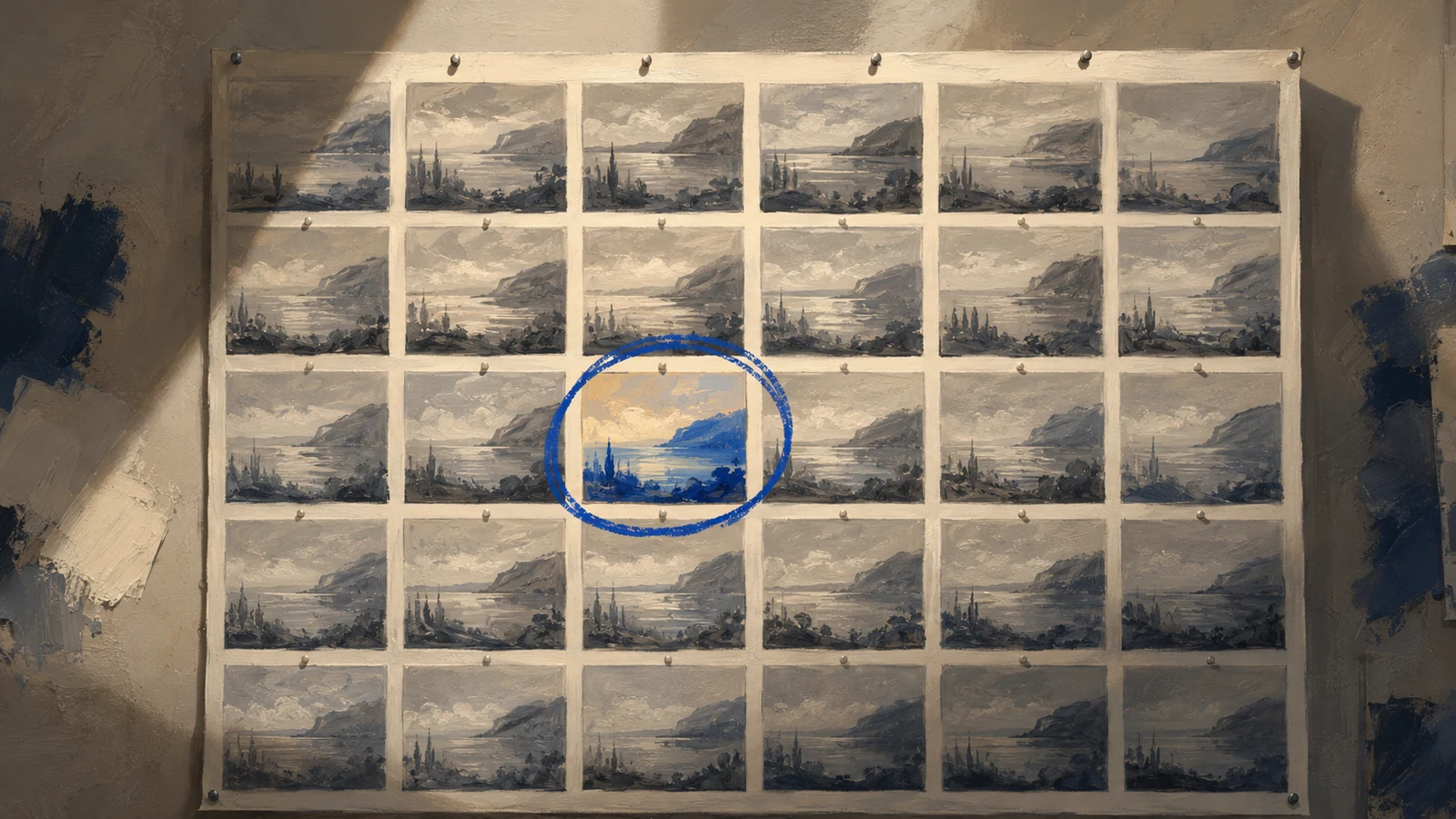
Made with ChatGPT (ChatGPT Images 2.0 (GPT-4o))view prompthide prompt
Create an editorial magazine illustration in a hand-painted style with visible soft brushstrokes and subtle oil-painting texture. NOT photoreal, NOT a 3D render. Palette: cool slate-navy and warm cream with selective deep cobalt blue accents, cinematic 16:9 widescreen. Composition: an overhead view of a large contact sheet or grid of many small near-identical illustration thumbnails pinned to a studio wall, most of them muted and faded into soft grey sameness, a single one near the center circled by hand with a confident deep cobalt blue grease-pencil ring and glowing slightly brighter than the rest, a clear sense of one chosen out of many by a discerning eye, warm directional light, no people, no hands, no readable text or letterforms. No people, no readable text, no logos.
Hero (LCP) for creatives #7 (use AI without slop) — 'the art is in the choosing.' Picked from the multi-model loop (ChatGPT/Gemini/MJ/Flux/SDXL): the ChatGPT take read the cull cleanest — muted grid of samey outputs, one keeper circled in cobalt, no people. Alternates lost on people (Gemini) or empty tiles (Flux/SDXL).
Let's start with the part nobody selling you an AI tool wants to sit in.
If you make things for a living, the last two years have probably included some version of this. You post something you drew or designed by hand, the way you've worked for a decade, and a stranger assumes a machine made it. A client forwards a logo their nephew generated for free and asks if you can just clean it up. Work that looks like yours, except hollow, fills every feed you scroll.
Designers are saying it out loud everywhere: sixteen years of craft, and now people see it and think it came out of a prompt. That one stings in a specific way, because being mistaken for the thing flooding the internet is its own small grief.
There's an official name for the flood now. Merriam-Webster made it the 2025 word of the year: slop.
And the fear underneath all of it is quieter and worse: that if you start using these tools in your own work, you'll turn into the thing you can't stand.
So this one is for the designer who actually wants to use AI in the craft, not just the back office, and is scared of exactly that. The manifesto in this series said to keep AI off the art. This is the companion piece. Here's how to let it into the work without losing the part that's yours.
The line isn't where AI touches the work. It's whether your judgment is driving.
Slop isn't a property of the tool. You can make slop with a pen. What makes the AI version of it so abundant is that the tool will happily supply the one thing it was never yours to outsource: the judgment about what's good.
Tanya Donska, writing in Built In about the AI design slop era, put the failure mode exactly: AI slop "resembles everything and argues for nothing." It's the average of every design ever fed to the model, rendered competently enough to clear any review it'll ever face. Competent. Positionless.
The thing that keeps your work on the other side of that line is taste, and taste is also the thing AI can't hand you. As designer Elizabeth Goodspeed wrote, "AI itself can't generate good taste for you." Brian Collins says the same thing from the other direction: the part a machine will never have is judgment, "the ability to know what not to make."
The art was never in the making. It's in the deciding. That's the part to keep both hands on.
Here's the catch the upbeat takes skip: taste is expensive. It's built over years of looking, copying, failing, and looking again. Which means the real danger runs deeper than one bad final edit. These tools let you ship work above the taste you've actually built, then quietly stop you from building any more. Practitioners have a name for it: the taste-skill discrepancy. The tools raise the floor, not your ceiling.
So keeping your judgment in the driver's seat means three places where your hands stay on the wheel: the front, the middle, and the end.
Keep your hands on the front: decide what you're making before the machine offers
The most common way good designers slide into slop is upstream of any prompt. They open the tool first, before they've decided anything, and let its first plausible suggestion become the brief.
Start in the analog. A sketch, a sentence, a scribbled point of view: set the logic of the thing before the machine gets a vote. The intent is the part a client is actually paying you for, and it's the one input AI genuinely cannot originate. AI that finishes a thought you brought is an amplifier. AI that supplies the thought is a replacement, and you'll feel the difference in how little the result is yours.
The illustrator Gary Hanna is a useful model here. He trains models on his own sketches and prompts them with almost nothing, because the point isn't to borrow a look off the internet. As he puts it, he treats his sketches like a scene he built and AI like the renderer. The vision is upstream, in his hand. The machine just does the rendering he aimed it at.
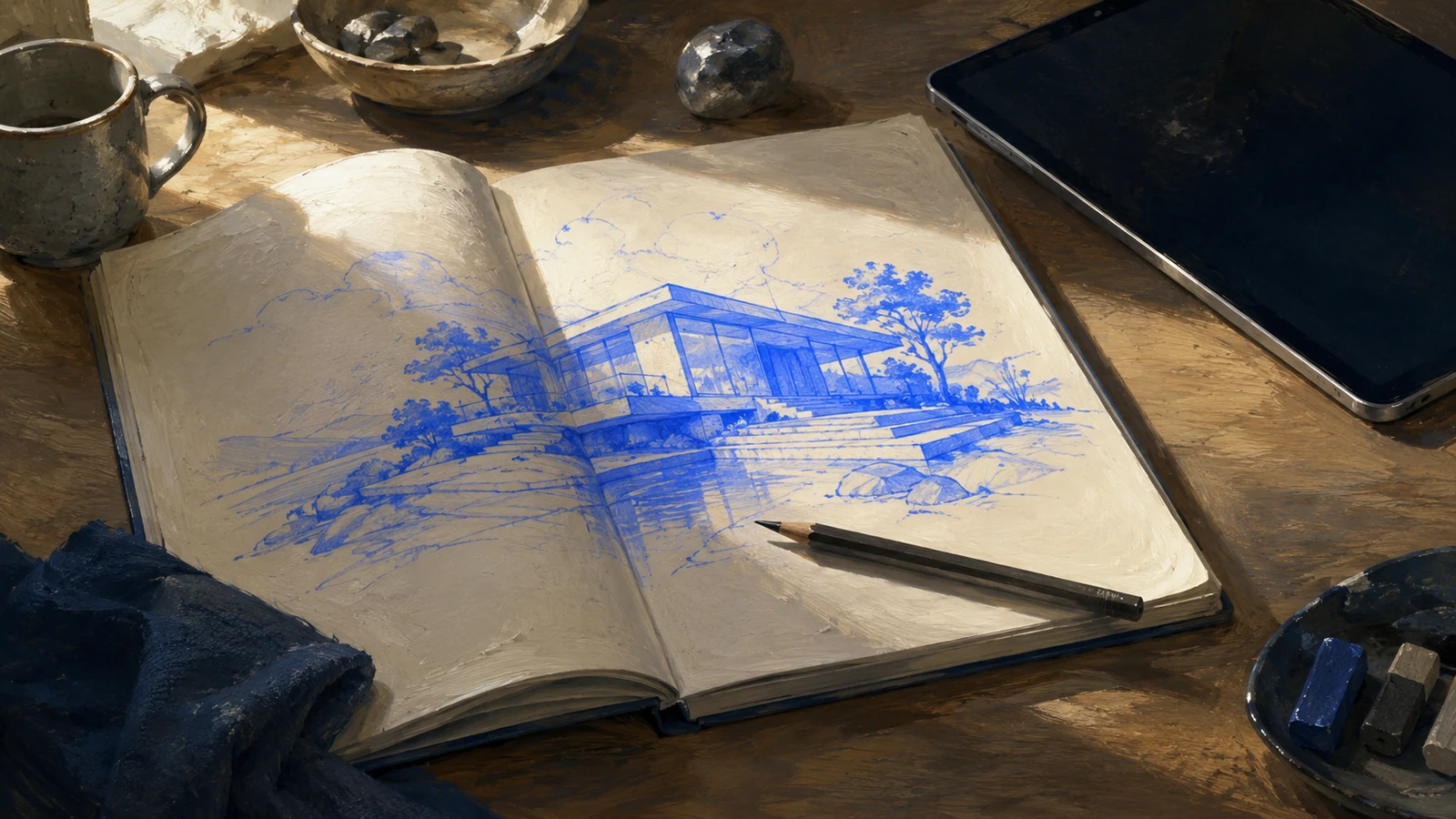
Made with ChatGPT (ChatGPT Images 2.0 (GPT-4o))view prompthide prompt
Create an editorial magazine illustration in a hand-painted style with visible soft brushstrokes and subtle oil-painting texture. NOT photoreal, NOT a 3D render. Palette: cool slate-navy and warm cream with selective deep cobalt blue accents, cinematic 16:9 widescreen. Composition: a still life on a warm wooden desk, an open sketchbook with a loose confident pencil sketch that glows softly deep cobalt blue as if it is the true source of an idea, a graphite pencil resting across it, a dark blank screen or tablet set quietly to the side waiting its turn, soft morning light, a sense that the thinking happened here first by hand, no people, no readable text or letterforms. No people, no readable text, no logos.
Mid (movement 1, 'the front') for creatives #7 — intent before the machine. Picked from the multi-model loop: the ChatGPT take gave the clearest analog-first story (blue-pen sketch as the real idea, dark tablet waiting to the side). Beat MJ (messy scrub) and the local lanes.
Keep your hands in the middle: don't outsource the muscle that makes you good
This is the one the all-upside crowd never mentions, and it's the one that actually erodes a career.
Skill comes from friction. The hours of doing the hard part badly, then less badly, are how the eye gets built. Hand every hard part to the tool the moment it's hard and the friction disappears, and so, eventually, does the eye. You don't notice it going. You just slowly lose the ability to tell your own good from your own slop.
The working rule that protects you: let AI do the parts you've already mastered, not the parts that are still teaching you. The roto you could do in your sleep, the fortieth export resize, the denoise on a noisy plate: hand those over and buy back your hours. The thing you're still learning to see, the composition you can't quite land yet, the type pairing that's almost right: stay in that. That's not grunt work. That's the gym.
Keep your hands on the end: the art is in the choosing
If AI is good at anything in the craft, it's volume. Twenty directions in the time you'd have sweated out one. That's a real gift, and it's also where most people stop, ship the first decent one, and call it done. Stopping there is the whole difference.
Justin Ahrens, writing in PRINT, framed the discipline cleanly: "Let AI widen the field. You narrow it." The widening is cheap now. The narrowing is the job.
The selection is not a clerical step after the creative work. It is the creative work. Which one, why that one, what to fix in it, what to throw out, what to put your name on: that's taste applied, and it's the thing nobody can prompt their way into. Generate broadly. Then cut ruthlessly, refine by hand, and own what's left.
Where AI actually earns its place in the craft
Plenty of working designers use AI in the actual work and don't make slop, because they aim it at assistance, not authorship. A few that hold up:
The graphics team on a network late-night show uses Runway to handle rotoscoping, the kind of tedious masking that used to eat hours. One artist did in five minutes a shot what used to take five. Nothing about the creative call changed. The drudgery did.
Designer Paul Hatton uses AI to upscale for print, kill noise, and recover detail in soft areas, while keeping, in his words, the reins. Product designer Nikita Samutin treats it as a "visual sparring partner": a source of alternatives to react to, not a source of finished screens. Even Aaron Draplin, no soft touch on this stuff, shrugged that when a friend needed vertical art made square and AI built the missing edges, "that's good".
The pattern across all of them: AI on the mechanical, the exploratory, the parts that were never the point. The judgment stays on the person. Reference, not output.
And where it reliably turns into slop
The other side is just as consistent. Slop is what you get when raw output becomes the finished bar.
The prompt-generated logo is the clearest case. As one creative director put it, generative tools are "very efficient copying machines", assembling from everything that came before without a thought behind any of it, which is also why AI logos drift toward looking like every other logo in the category. Untouched AI copy reads grammatically perfect and completely forgettable. The generic AI hero image is visual elevator music. None of it is wrong, exactly. It just resembles everything and argues for nothing, and your audience clocks the hollowness even when they can't name it.
The test is simple. If you couldn't defend each choice in the piece to another designer, you didn't make those choices. The model did, and you shipped its average.
The reason any of this matters more now, not less, is that the hollow stuff made the real thing scarce. Companies are already hiring people to fix the slop they generated; one marketplace reported demand for that kind of cleanup jumping 250% in six months. The taste you've spent years building is the appreciating asset. Don't trade it for speed.
And if the reason you never get the hours to keep building it is that your week is buried in intake, proposals, and invoice-chasing, that's the half we'd actually touch. We automate the business around the work, on purpose, so the craft stays yours and you get more time inside it, not less. If that's the trade you want, start a no-pressure conversation, or read what to automate first.
Cheers, from the boring side of the business,
P.S. A test, if you want one. Take the last thing you made with AI in the loop and try to defend every choice in it to another designer, out loud. The parts you can defend are yours. The parts where you hear yourself say "that's just what it gave me" are the parts to go back and make yours. That's the whole method.
Want help applying this to your business? Start a no-pressure conversation →
Frequently asked questions
- How do you use AI without making AI slop?
- Keep your judgment in control at every stage. Decide what you're making before you prompt, use AI to widen your options rather than to finish the piece, and own the final selection and refinement. Slop is what happens when you outsource the judgment, not when the tool touches the work. The tell of slop: it's technically competent, clears every review, and argues for nothing.
- What is AI slop?
- Low-quality content produced in quantity by AI with little regard for whether it's any good. Merriam-Webster made "slop" its 2025 word of the year. In design specifically, it's the averaged output that resembles everything and means nothing: the generic hero image, the prompt-generated logo, the grammatically perfect, completely forgettable AI copy.
- What parts of creative work should you not hand to AI?
- Three: the intent (the brief, the point of view, the reason the thing exists), the skills you're still building (outsource those and they atrophy before they form), and the final selection and refinement. The middle, the grunt work you've already mastered, is where AI earns its place. The judgment around it stays yours.
- Can you copyright design work made with AI?
- In the US, purely AI-generated output is not copyrightable, and a prompt alone doesn't make you the author. Work where a human makes meaningful creative selection, arrangement, or modification can be registered, but the protection covers only the human-authored parts. Practically: a logo typed out of a prompt may be something neither you nor your client can fully own or defend, which is a business reason to keep your hands on the work.
- Does using AI make you a worse designer?
- It can, if you let it. The risk is skill atrophy: if you skip the friction that builds your eye and outsource judgment you haven't developed yet, you end up able to ship above your own taste and unable to see your own slop. Used on work you've already mastered, while you keep the thinking and the choosing, it doesn't. The deciding factor is what you protect.

Know someone who needs this?