The proposal that was already lost
You spend hours on a beautiful proposal, send it, and it comes back reduced to one line: the price. Here's why the value comparison was lost before you ever hit send, and where it's actually won.
 ChatGPT
Same prompt, 3 AI models — swipe to compare. Showing 1 of 3.
Made with ChatGPT (ChatGPT Images 2.0 (gpt-image-2))view prompthide prompt
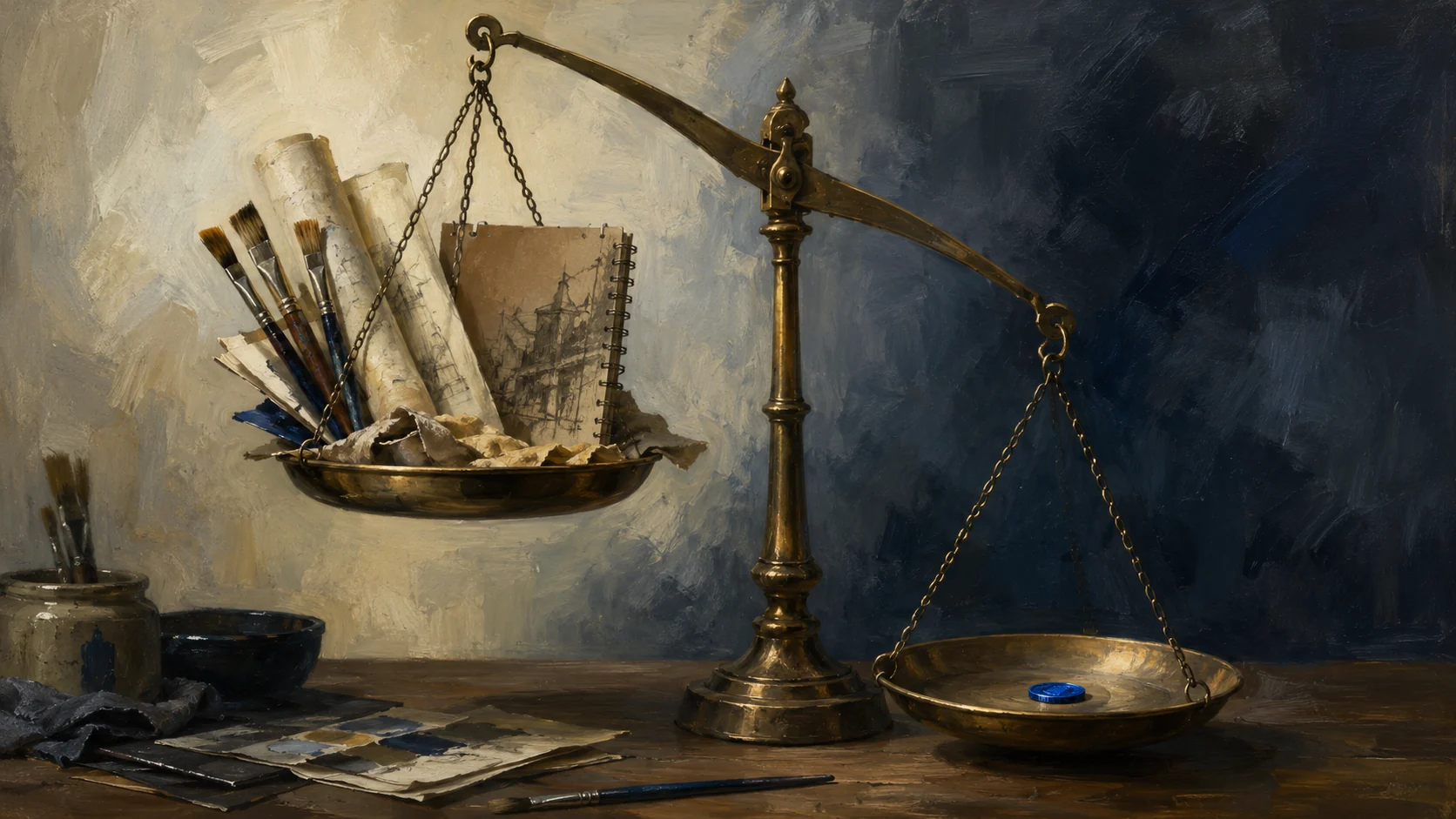
Create an editorial magazine illustration in a hand-painted style with visible soft brushstrokes and subtle oil-painting texture. NOT photoreal, NOT a 3D render. Palette: cool slate-navy and warm cream with selective deep cobalt blue accents, cinematic 16:9 widescreen. Composition: an old brass balance scale on a desk; one pan holds a rich, warmly-lit bundle of creative work (rolled designs, brushes, a sketchbook) but sits HIGH, raised and ignored; the other pan holds a single small cold coin glinting cobalt and sits LOW, having won. A clear sense of valuable craft being outweighed by one small number. No people, no readable text, no logos.
Hero (LCP) for the proposals piece. The work judged on price alone, outweighed by a coin. Non-phone. Gemini take in the carousel: art14-scale-gemini.
You spent the better part of a day on it.
A real proposal. The brand work scoped out properly, a timeline that made sense, a couple of options, a fair number you talked yourself into not lowering. It looked like something a serious studio sends. You read it twice and hit send a little proud of it.
Then nothing. A day. Three days. You start refreshing your inbox like it owes you money.
When the reply finally comes, it's kind, and it's short. “Thanks so much for putting this together, it looks great! We've decided to go a more budget-friendly route for now, we're going to try a few things in-house first. We'll absolutely keep you in mind.” In-house. You know what that means this year.
So you do the thing everyone does. You assume the number was too high. Next time you'll trim it, or you'll write three more paragraphs explaining why it's worth it. You file it under priced myself out and move on, quietly a little smaller than you were that morning.
The price was never read on its own
Here's what actually happened to that proposal. It got opened, alone, on a screen, days after you last spoke, by someone half-deciding between you and two other tabs. And on the whole document, the one concrete, comparable thing was the price.
Everything else, the craft, the thinking, the outcome, was words. Words are easy to skim and impossible to weigh. The number is right there, exact, and it has a tab open next to it with a smaller number on it. So that is the only contest that happens. Not your work against their other option. Just your number against a cheaper one, and lately, against a twenty-dollar subscription that promises ninety percent of the thing for five percent of the cost.
The proposal didn't lose on price. It lost because a number showed up before the value did.
A proposal that opens with a deliverables list and a fee is, functionally, a menu. And nobody reads a menu and thinks about value. They read it and they price-shop, because that is the only thing a menu is built to let you do.
The sale doesn't happen in the document
The people who have spent careers pricing creative work, Blair Enns, Jonathan Stark, the ones who wrote the actual books on this, all say a version of the same blunt thing: the proposal should never be the first time money comes up. By the time you are writing one, the deal is mostly already decided. The proposal is the receipt, not the pitch.
Which means the part you have been treating as paperwork, the conversation before the proposal, is where the whole thing is won or lost. That call is not a formality on the way to sending a PDF. It is the sale.
On it, you do three things a document cannot do for you. You get them to say out loud what the outcome is actually worth to their business, and what it costs them if it goes wrong, the rebrand that confuses their customers, the site that quietly leaks every third lead. You find out what they can actually spend, before you have written a single line for free. And you put a number in front of them while you are still in the room to frame it, watch their face, and answer the flinch.

Made with ChatGPT (ChatGPT Images 2.0 (gpt-image-2))view prompthide prompt
Create an editorial magazine illustration in a hand-painted style with visible soft brushstrokes and subtle oil-painting texture. NOT photoreal, NOT a 3D render. Palette: cool slate-navy and warm cream with selective deep cobalt blue accents, cinematic 16:9 widescreen. Composition: two empty chairs drawn up close to a small wooden table in warm, inviting light with a soft cobalt glow, a real face-to-face conversation about to happen; a folded proposal or document lies face-down and set aside at the edge of the table, waiting its turn. A sense of the value conversation that happens before any number. No people, no readable text, no logos.
Mid image, the fix. The value conversation that comes before the price; the proposal set aside until after. Non-phone.
So what is the proposal even for?
It documents the thing you already agreed to. Done right, it opens with their problem in their words, not your service list, so the first thing they read is proof you understood the stakes. The number sits where it belongs, after the value, framed by it, never naked on the page.
Give them options if it fits, usually three. The expensive one is not there to be picked. It is there to make the middle one look like the reasonable adult in the room. Some studios do better with a single, confident price and no menu at all. The count is not the point. The point is that the number never shows up without the value standing right next to it, holding its hand.
A good proposal can't win what the conversation didn't. It can only keep from losing it.
Where AI fits, and where it doesn't
Because the question is coming: can't AI just write these now? Some of it, yes, and the honest answer is worth saying plainly. AI will brand your template, beat the blank page, and turn the notes from your call into a competent first draft in about a minute. If you are still building each proposal from scratch in a blank document, that part is a solved problem, and you should let a tool do it.
What it cannot do is the part that actually closes anything. It cannot run the value conversation, cannot read the room, cannot decide what your work is worth or stand behind the number when the client pushes. It automates the document around the proposal. The judgment inside it, the thing the client is genuinely paying for, stays yours. That is the whole position: hand the paperwork to the machine, keep the part that only a person who has done the work can do.
Some clients were gone before you spoke
One hard truth, because pretending otherwise would make this whole piece a lie. Some of the clients you are losing were never yours to lose. They had already decided, before they ever emailed you, that AI or the cheapest freelancer was good enough, and they were really just collecting a number to confirm it. No proposal on earth reframes that. You will usually never even get the chance to try. They just go quiet.
That is not a proposal problem, and it is not a price problem. It is a positioning problem: somewhere upstream, you became interchangeable with a subscription. The fix for that one lives in a different decision entirely, about being the studio a client cannot simply swap out. A sharper proposal wins back the client who is still deciding. It cannot reach the one who already has.
If your proposals keep coming back as a polite note about budget, the document is not the problem and neither is your number. The conversation that was supposed to happen first never did. Start a no-pressure conversation and we'll fix the order: where the value gets established, where the number goes, and what the proposal is actually allowed to carry. You keep doing the work. The number stops being the first thing they see.
Cheers, from the boring side of the business,
P.S. That's the front of the business walked end to end now: the “AI can do it free” objection, the line scope creep crosses, the inquiry that goes cold, and the proposal that prices it. The last one in the series puts them in order, what a creative studio should actually automate first. See you there.
Want help applying this to your business? Start a no-pressure conversation →
Frequently asked questions
- Why do my proposals lose on price?
- Usually because the proposal is the first place the client sees a number, with no value established next to it. A document that leads with a deliverables list and a fee reads like a menu, so the only thing left to compare is the price, against a cheaper studio or against AI. The fix is to have the value conversation before the proposal exists, so the proposal confirms a decision instead of starting a negotiation. Trimming the number or padding the justification just treats the symptom.
- Should I put options in a proposal or a single price?
- Either can work, and the count matters less than the sequence. Three options let the client choose where to land, and a deliberately high option makes the middle one look reasonable. A single, confident number works too when you're sure of the value. The thing that loses the deal is a price that arrives naked, with no outcome standing next to it. Establish the value first; then the number, however many you show, has something to be measured against.
- How do I stop competing with AI on price?
- Not in the proposal. If a client has already decided AI is good enough, no wording saves that deal, and that's a positioning problem, not a proposal problem: you became interchangeable with a $20 subscription. The defense is upstream, being the studio they can't swap out, and the value conversation, where you make the cost of getting it wrong concrete. A proposal can shift a client who is still deciding. It can't reach one who already decided before you talked.
- Should I send a proposal before talking about budget?
- No. Writing a full proposal before you know the budget is how you end up doing free consulting for someone who was fishing for a number. Qualify the budget on the call, where you can also establish what the work is worth. The people who price creative work for a living are blunt about this: the proposal should never be the first time money comes up.
- Can AI write my proposals?
- It can do the paperwork, not the judgment. AI will brand your template, beat the blank page, and turn your call notes into a competent first draft. It cannot run the value conversation, decide your price, or originate the outcome framing that makes the work worth more than its parts. Used well, it automates the document around the proposal and leaves the thinking, the part a client is actually paying for, to you.

Know someone who needs this?