What's the right play on after-hours calls in a home-services business?
A 2 a.m. call about a basement flood. The story of what happened — and what would have happened with a triage layer in front of the phone.
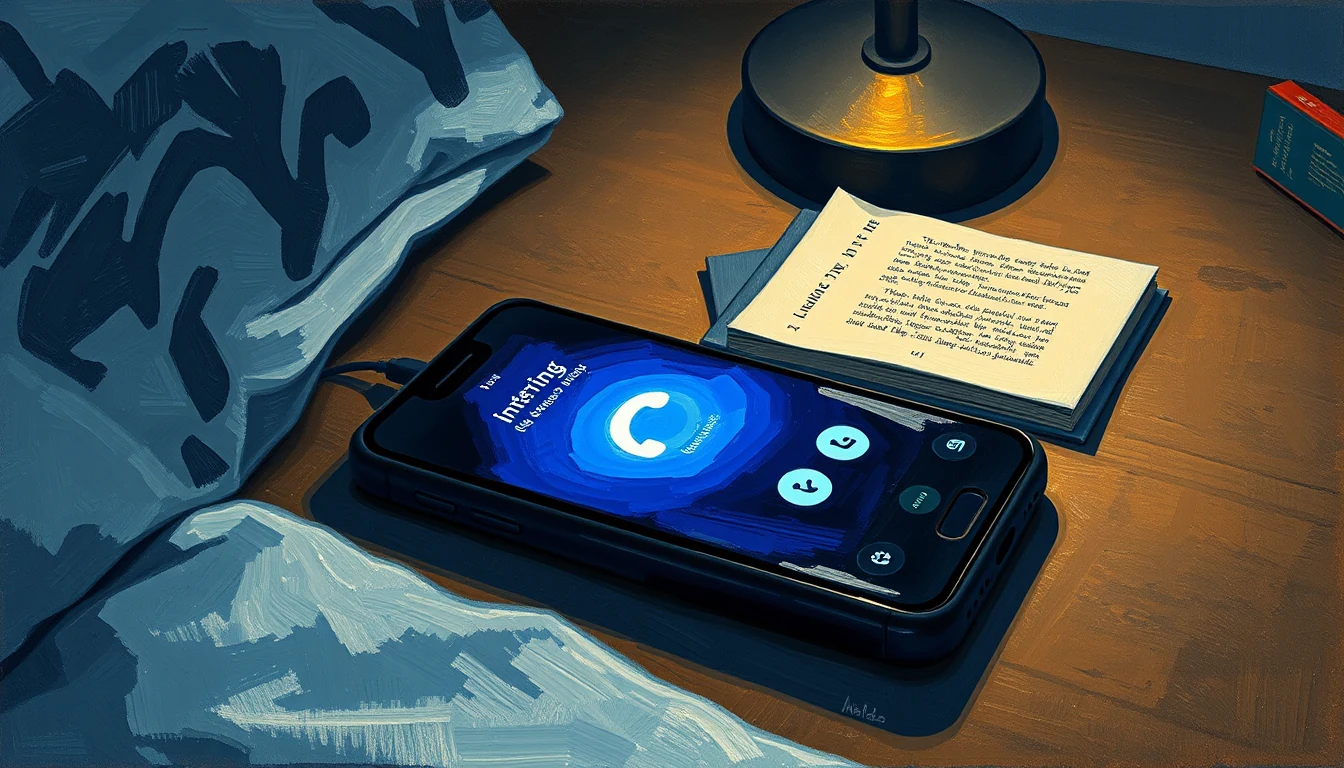
Made with ComfyUI (local) (ComfyUI · Flux.1 Schnell (fp8) · 1344×768 · scheduler default / steps 4 / cfg 1.0)view prompthide prompt
editorial magazine illustration, hand-painted with soft brushstrokes and subtle painterly texture, refined color palette of cool slate navy and warm cream paper with selective deep cobalt blue accents, considered composition, professional editorial quality, no text, an intimate nightstand still life at 11 p.m., overhead view, a phone lying face-up on a wooden nightstand with its screen glowing a luminous cobalt blue from an incoming call, a closed paperback book and a small warm lamp beside it, the corner of an unmade bed faintly visible in soft shadow, quiet weighty end-of-day mood, no people, no readable text on the screen
Flux 01 chosen over SDXL — SDXL's Painted World LoRA kept rendering a vintage rotary phone instead of a modern smartphone. Flux's cleaner register gets the literal scene; brand register accepts the trade for this article.
The call came in at 2:14 a.m. on a Wednesday in February. The owner of a one-truck plumbing shop on the west side — let's call him Dave — had been asleep for about three hours when his phone lit up the bedroom.
He looked at it. He didn't look at it. He looked at it again, the way you do when you're trying to decide whether you're the kind of person who answers.
He answered.
A woman's voice, half a beat too fast, in the middle of a sentence she'd already started in her head. Something about water. Something about the ceiling. Something about three of her friends already telling her she should have shut the main off twenty minutes ago.
Dave sat up. Asked where the water was coming from. Asked if she could get to the main shutoff and how high the water was getting. Asked her address. The whole conversation lasted four minutes. By the end of it he'd said yes, he could be there in forty, and was pulling his work pants on in the dark while she was still saying thank you.
He got there at 3:02. Half-inch supply line behind the upstairs toilet, split clean from a freeze nobody had predicted. Maybe three hundred gallons across two ceilings and a hallway floor. Real job. The kind of job that justifies the phone call.
He was home by 5:40. Slept until 7:15. His first scheduled job that morning was at 8:00 across town, a water-heater quote he didn't reschedule because he never reschedules, and he showed up to it with the kind of face you get when you've slept four hours in pieces.
He nailed the quote anyway. He's good at his job. The homeowner didn't notice. Dave noticed.
Now rewind to two weeks earlier, same Dave, same one-truck shop, different Wednesday. A different call, this one at 10:20 p.m. A homeowner with a slow drain in her kitchen sink, asking if it was something Dave could come look at tomorrow or whether she should be doing something about it tonight.
Dave's exact answer, tired and almost in bed: "yeah no, that one's fine for tonight, give me a call around eight in the morning, we'll get you scheduled."
Reasonable answer. Honest answer. He finished brushing his teeth and went to sleep. She didn't call back at eight. She called somebody else at eight, because between the time she hung up and the time she went to bed she decided she didn't love the answer she got, and the guy who picked up the next morning at 7:55 was already at her house by 9.
Dave never knew any of that. He still doesn't. From his side of it, the call just stopped existing — a homeowner he talked to once, briefly, who didn't follow up, who he forgot about by Friday.
Those are the two ways an after-hours call can go wrong on a one-truck shop. Wake up for a real one and tax tomorrow. Half-deflect a small one and lose the customer you didn't know you had.
Wake up for a real one and tax tomorrow. Half-deflect a small one and lose the customer you didn't know you had.
We started working with Dave about a month after the basement flood, when he was finally willing to admit that the schedule was running him instead of the other way around. He didn't want a new system. He wanted his nights back without losing the calls he was actually supposed to take.
So we built one layer in front of the phone.
Every call that came in after 8 p.m. — voice or text — would now hit a triage line first. It picked up on the first ring. Asked the same two or three questions Dave would have asked if he'd been awake. Listened to the answers. Decided where to send the call next.
Three places it could go.
If the homeowner used words like flooding, gushing, no water, no heat-in-winter, sparks, smell of gas, or anything that walked close to those — Dave's on-call cell rang within sixty seconds with a one-paragraph summary of what was happening and where. Real emergency, real interruption, both earned.
If the call was a thing that could wait a few hours — a sink that was dripping but contained, a quote for a job, a question about the previous week's invoice — the system offered the first 7 a.m. slot, booked it, and sent the homeowner a confirmation text. Dave's phone stayed quiet. The work landed on tomorrow's schedule, already locked in, with a written record of what the homeowner said the problem was.
And if it was something else — a wrong number, a sales call, a homeowner asking what hours the shop kept — the system handled it, told them when they'd hear back, and queued the followup for 8 a.m. so a person never had to.
- 1Capturesevery after-hours call, first ring
- 2Asksthe 2–3 questions you would ask
- 3Routesemergency → cell · schedulable → morning · other → queue
- 4Confirmstext to the homeowner, no silence
Designed with ChatGPT (design reference), built as codeview prompthide prompt
A clean vertical flow diagram, 4 stacked steps connected by downward arrows: 1 CAPTURES, 2 ASKS, 3 ROUTES, 4 CONFIRMS. Each step a rounded rectangle with a cobalt-blue left edge, cream fill, slate text. Minimal editorial infographic style, generous whitespace, legible accurate text.
Uses the same FollowUpFlow React component as the lead-follow-up infographic, but the steps and accessible alt text are specific to after-hours triage — separate credit entry preserves AEO accuracy per article.
The thing we didn't fully appreciate going in was how few of the after-hours calls were the real-emergency kind.
When we looked at Dave's call log from the four weeks before triage went in, he'd answered thirty-four calls between 8 p.m. and 6 a.m. Seven of them were the kind he was supposed to interrupt his life for. The rest were quotes, questions, callbacks, two telemarketers, and one homeowner who wanted to know if Dave knew a good HVAC guy.
In other words: twenty-seven interruptions a month for what could've been a confirmation text and a calendar booking.
Three weeks after we turned the triage on, Dave's wife noticed first. She asked him at breakfast on a Sunday whether something was broken about the on-call setup, because the phone hadn't woken her once that week. It hadn't, because it hadn't needed to.
If you're sitting with this and wondering whether your own after-hours problem is more like Dave's first call or his second, here's the way to think about it. Take the call you'd be most worried about getting tonight at 2 a.m. and tick whichever of these apply to it.
Two or more, and the call earned the interruption. Most after-hours calls don't tick more than one box — which is the whole reason a triage layer in front of the phone is the right wrapper around your nights. The rare call that lights up three or four of these is the call that should always route through, every time.

Made with ChatGPT (ChatGPT Images 2.0 (gpt-image-2))view prompthide prompt
Create an editorial magazine illustration in a hand-painted style with visible soft brushstrokes and subtle oil-painting texture. NOT photoreal, NOT a 3D render. Palette: cool slate-navy and warm cream with selective deep cobalt blue accents, cinematic 16:9 widescreen. Composition: a still kitchen counter at sunrise, a ceramic coffee mug with steam rising, a phone lying face-down on the wooden counter, warm morning light through a window, no people, calm domestic stillness, the morning after a quiet night. No people, no readable text, no logos.
Placed before the closing 'Dave still gets woken up' section to mark the visual transition from 'what triage did' to 'what his life is like now.'
Dave still gets woken up. Less than once a week now, instead of three or four times. When he does get the call, he answers it knowing it's the kind worth answering — because by the time his phone rings, something has already filtered for that.
He doesn't think about the triage layer most days. He thinks about it on Monday mornings when he opens his schedule and finds the cancellations from Friday night already backfilled, and the Saturday quotes already booked into Wednesday's first slot, and the kitchen-sink lady from three months ago — the one he didn't lose — leaving a five-star review for a different job he did in March.
That's the real thing the layer does. It doesn't just protect the nights. It protects the mornings, too — by routing the small calls toward outcomes you'd choose if you were awake, instead of the outcomes you produce when you aren't.
Related reading: Why the first contractor to call back wins the job, and AI scheduling and dispatch without replacing your existing software.
If you want a straight read on which of your own after-hours calls earn the interruption and which don't, start a no-pressure conversation. We'll look at the actual call log before recommending anything.
Cheers, from the boring side of the business,

P.S. Dave's wife now goes to bed at 10 p.m. instead of 11. She says she finally trusts the phone to stay quiet. He's slightly insulted by this and also relieved.
Want help applying this to your business? Start a no-pressure conversation →
Frequently asked questions
- How many after-hours calls in home services are actually emergencies?
- Fewer than it feels. Most one- and two-truck shops we work with find that roughly a third to a half of their after-hours calls are real same-night work — burst pipes, no-heat-in-winter, sparks. The rest are bookings, quote questions, and the occasional wrong number that didn't need anyone to lose sleep over.
- Won't a triage system miss the call that actually mattered?
- Only if you set it up that way. A well-tuned triage layer errs toward waking you — when the homeowner says "water everywhere," "no heat," or "smell of gas," the call goes straight through. False alarms on the on-call line are fine. Missed real ones are not, so the system is built to fail in the right direction.
- How does the system know which calls are emergencies?
- It listens for the same signals you would — words like flooding, sparking, smoking, gas, no heat or AC, a vulnerable person in the home. Those route to your on-call phone in under a minute. Everything else gets a friendly first response and a slot on tomorrow's schedule, with a text confirmation so the homeowner isn't left wondering.
- Do I have to be the one taking the after-hours emergency calls?
- No, but you have to have a real on-call rotation. The triage layer doesn't replace having someone available — it makes that rotation easier to actually run, because the person on call only takes the calls that earn the interruption.
- How long does it take to set up after-hours triage?
- For a small home-services business, a focused setup is usually live in a week or two. The slowest part is writing down your real rules — what counts as an emergency for your trade, what your on-call phone is, what your morning schedule looks like — and the system follows from there.

Know someone who needs this?