How do you turn one-time service calls into repeat customers?
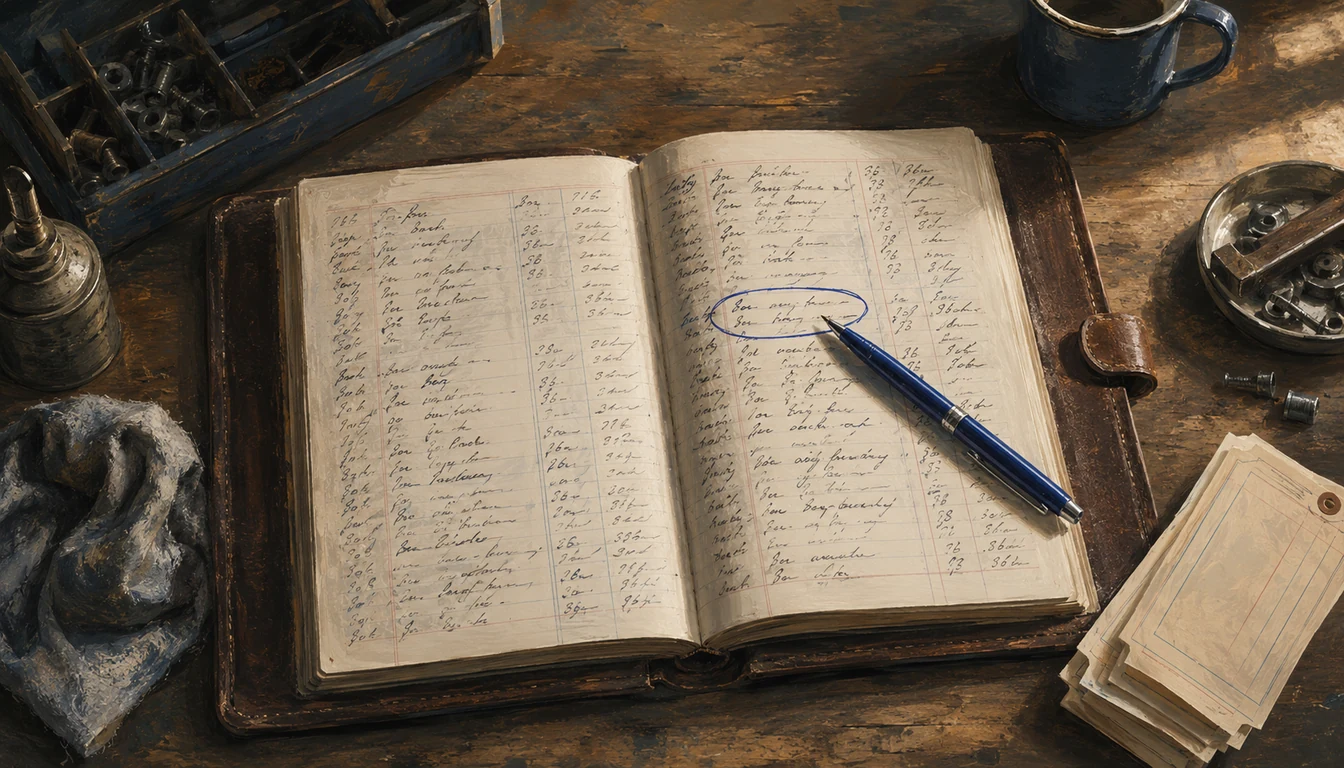
Your customer list is a book you've stopped opening. The new customers you keep buying are pages in a different book — paper-thin, expensive, easy to lose. Here's what happens when you start opening the first one again.
Made with ChatGPT (ChatGPT Images 2.0 (gpt-image-2))view prompthide prompt
Create an editorial magazine illustration in a hand-painted style with visible soft brushstrokes and subtle oil-painting texture. NOT photoreal, NOT a 3D render. Palette: cool slate-navy and warm cream with selective deep cobalt blue accents, cinematic 16:9 widescreen. Composition: an overhead view of a wooden workshop desk in soft afternoon light, a leather-bound customer ledger lying open across the center with impressionistic cursive ink entries that are not legible up close, a deep cobalt-blue pen resting across one entry that has been circled in cobalt ink, a small stack of completed paper service tickets tucked into one corner, no people, no readable text. No people, no readable text, no logos.
Your customer list is a book you've stopped opening.
Every closed ticket from the last six years is in there. Names, addresses, what you did for them, when, what equipment you installed, who you talked to on the phone. Six hundred pages, eight hundred, two thousand depending on how long you've been at it.
You don't read it. You don't even know where it lives — somewhere inside ServiceTitan or Jobber or Housecall Pro, accruing at the rate of about three new pages a week, untouched the entire time.
And every Monday morning you spend more money buying pages for a different book — a thinner, paler, more expensive one called "new leads from Angi." Pages that cost you fifty or sixty bucks apiece, that don't know you, that buy in eight times out of ten unless somebody answers them inside six minutes.
Your customer list is a book you've stopped opening. You buy pages for a different one every Monday.
The math is the part most owners can recite. Acquiring a new customer costs three to five times more than keeping one you already served. Everybody in home services has read that line. Most of them still spend the budget on new leads the next morning, because the book full of old customers feels passive, and the spend on new ones feels active, and the difference between feeling busy and being effective is harder to notice than it should be.
So this article isn't going to talk you into believing the math. You believe the math. This article is about what it looks like to actually open the book.
The book you buy pages of every Monday
- $50–$60 per page, sometimes more
- Pages don't know you, you don't know them
- Eight in ten don't buy unless answered in six minutes
- You start over every page, every week
The book sitting on your shelf
- Already paid for, six years deep
- Every page already trusts the work
- Each page knows what equipment is in the house
- Compounds quietly with every job you close
The first page — the day after
Open the book to the page from yesterday. Not your top customer. Not your biggest job. Yesterday's job. The one you closed out around 4 p.m. and haven't thought about since.
Send the homeowner a short note tomorrow morning. "Hope the dishwasher's behaving today. Anything we should look at before we close out the ticket?"
Two things happen. The small issue you would have heard about as a callback complaint in three weeks comes back as a fixable question in twenty minutes. And the door stays open — so when she texts you in March about an unrelated quote, it doesn't feel weird, because the last time she heard from you was a note that read like a friend checking in.
Most shops can't sustain doing this manually. Tomorrow morning the next job is happening, and then the next, and the dishwasher is two days old, and then it's a month, and you didn't send the note. The fix is that the note goes out on its own, in your voice, the morning after every closed ticket, forever. You wrote it once. The book sends itself.
The seasonal page — turned by the calendar, not the blast
Every trade has its weather, and the weather changes by climate. HVAC has the two tune-ups a year — one before cooling season, one before heating — that work most places. Plumbing has its own moments: drain checks before the holidays, outdoor-spigot reminders before the freeze in cold climates, water-quality checks after monsoon season elsewhere. Electricians have the storm-season surge-protection note. Roofers have the post-storm inspection round.
The wrong way to use those is the email blast. Same Tuesday, the whole list, "Spring HVAC Tune-Up Special — 15% Off!" The homeowner reads it, doesn't open it, eventually unsubscribes. You blew the page.
The right way is to nudge each customer off the date of their last service. The note that lands six months and one week after the homeowner's last tune-up — when she's actually due — reads as service. The one that hits her on the same Tuesday as everyone else reads as spam.
Most owners who turn the seasonal page well discover something humbling on the first try: a lot of the customers were waiting for the reminder. They'd been meaning to call. They just hadn't, and they'd have called somebody else if you hadn't gotten there first.
The third page — the one most owners never turn
This is the one that pays for the book.
You already know when the water heater was installed. It's in the ticket from three years ago. When it crosses ten years, the homeowner gets twitchy. She googles "how long does a water heater last." She mentions it to her neighbor. She's two months from a replacement decision, and the company that calls her at year ten gets the job. The company that waits for the failure call competes with whoever the homeowner googles in a panic at 6 a.m.
Same play for furnaces around fifteen, AC condensers around twelve, roofs at twenty, electrical panels at thirty. The data is in your software. You filed it yourself, on the install day, and then never looked at it again.
Water heater · ~10 yrs Furnace · ~15 yrs AC condenser · ~12 yrs Roof · ~20 yrs Electrical panel · ~30 yrs
Turn the page once. Set the nudge to fire on the year that matters for each piece of equipment. The book reads itself from then on. The first homeowner who replies "how did you know?" tells you you've got something. The second one books the job.
The last page — the review ask, sent while the work is fresh
Most owners ask for reviews when they remember to, which is roughly never, and especially never on the jobs that would have earned the best ones.
The fix is to send the ask the day the work is done, while the homeowner is grateful, before the gratitude wears off. One short text. One link to your Google business profile. A useful soft fallback if she's not a Google person — "a note for our website is just as good." Sent every time, not just when you remember.
The reviews aren't just there to bring new customers through the door. They're the proof the next homeowner reads before deciding whether to call you back from your 24-hour text. They're the page that all the other pages refer to.

Made with ChatGPT (ChatGPT Images 2.0 (gpt-image-2))view prompthide prompt
Create an editorial magazine illustration in a hand-painted style with visible soft brushstrokes and subtle oil-painting texture. NOT photoreal, NOT a 3D render. Palette: cool slate-navy and warm cream with selective deep cobalt blue accents, cinematic 16:9 widescreen. Composition: a leather-bound ledger closed and sitting on a wooden workshop shelf, partially obscured by a stack of receipts and a coffee tin, warm shop-floor light slanting in from the left, no people, quiet sense of something forgotten on a shelf. No people, no readable text, no logos.
Placed between the four 'pages' of the book and the closing math, to visually anchor the running metaphor as the article approaches its punch.
Open the book on all four pages and the economics shift faster than most owners expect.
The HVAC shop that turns on the spring-tune-up nudge in February finds that March answers it. The roofer who turns on the post-storm inspection note hears back inside two weeks. The plumber who sends the 24-hour text on yesterday's job catches three small follow-ups a month he otherwise would have heard about as one-star reviews.
Inside a season, the cost of opening the book is paid for several times over. You haven't stopped acquiring new customers — that's not the point. You've just stopped paying acquisition prices for revenue you already had a claim on.
The book is sitting on the shelf. You can keep buying paperbacks from Angi every Monday, or you can read the one you wrote yourself.
Related reading: What's the right play on after-hours calls in a home-services business?.
If you want a look at which retention move would pay back fastest for your specific trade and customer list, start a no-pressure conversation. We'll look at your existing customer history before suggesting anything.
Cheers, from the boring side of the business,

P.S. 60-second test: open your software, filter by jobs closed twelve months ago, count the customers you haven't heard from since. Whatever the number is — that's the size of the page you stopped turning.
Want help applying this to your business? Start a no-pressure conversation →
Frequently asked questions
- Why do home-services businesses lose so many one-time customers?
- Because nobody followed up. The work was good, the customer was happy, and then they didn't hear from you for two years until they needed something again — by which point they'd lost your number and Google answered first. The job ends when the tech leaves; the relationship has to be reopened deliberately.
- Isn't follow-up marketing annoying to homeowners?
- Only the bad kind. A genuinely useful note — "your water heater is six years old, here's what we'd watch for" — reads as service. A blast of promotions reads as spam. The difference is whether the message helps them or helps you, and the homeowner can tell the difference in one sentence.
- How fast do these retention moves pay back?
- Faster than new-customer acquisition usually does. A returning customer doesn't cost you another lead-gen dollar, they already trust the work, and they refer faster than first-timers. Most shops we look at see the retention layer cover its own setup inside a season — sometimes inside a single seasonal cycle.
- Do I need a CRM to do this, or can I do it in my existing software?
- Most field-service platforms (ServiceTitan, Jobber, Housecall Pro) already store the customer history you need — service date, equipment installed, last contact. The retention moves layer on top of that data. You don't need a separate CRM; you need the data you already have to actually do something.
- What's the most overlooked retention move for home services?
- The equipment-age reminder. Most owners track the install date in their software and then never look at it again. A nudge when a water heater crosses ten years, when a furnace crosses fifteen, when a roof crosses twenty — those are the moments the customer is open to a call, and the company who reminds them is usually the one who gets it.

Know someone who needs this?